Webhooks
Get told when payments settle, and check the message really came from your server.
A webhook is a URL on your backend that Kite sends events to: every transfer status change, deposit, recovery and excess refund in an app.
Adding a webhook
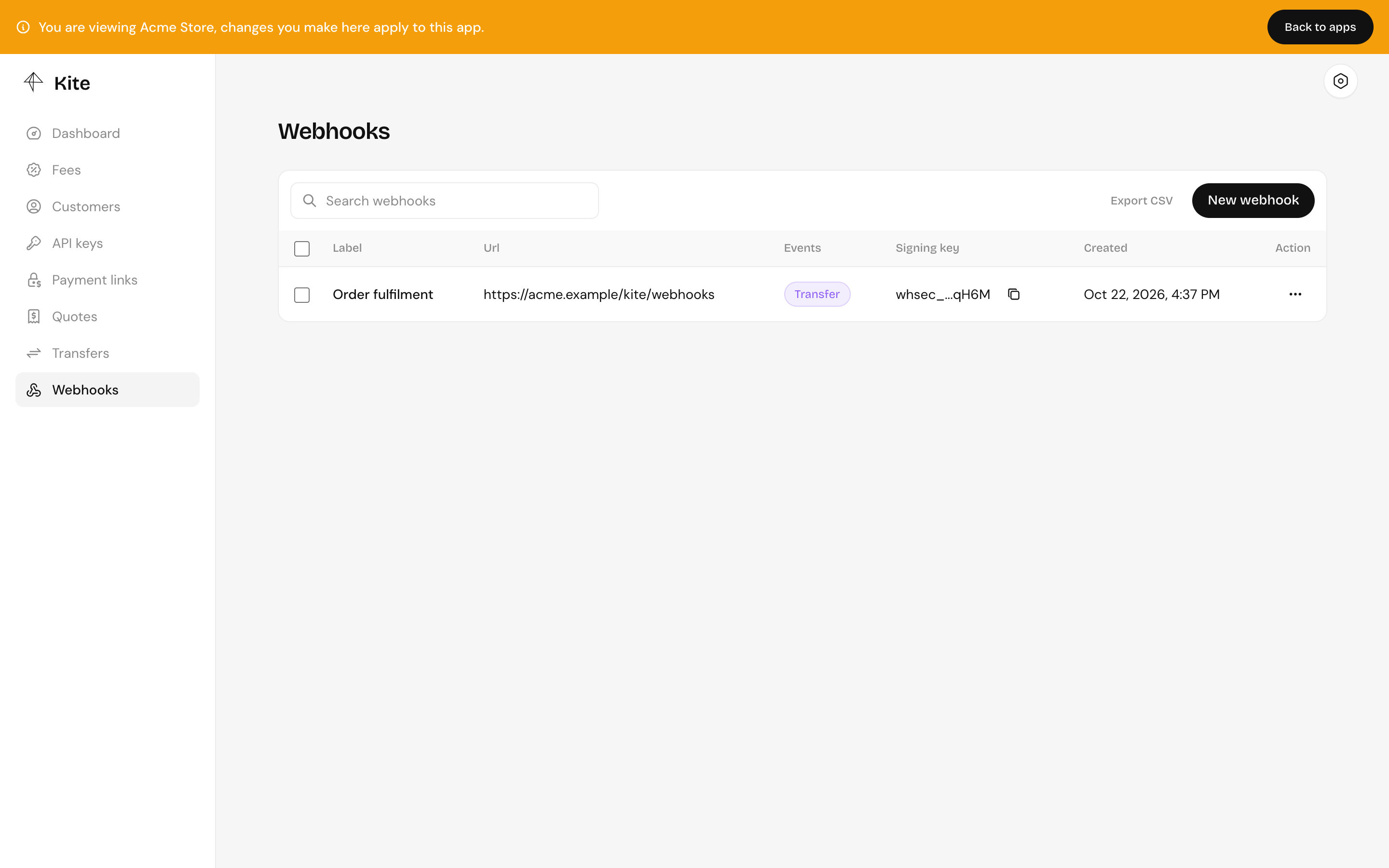
Inside an app, open Webhooks and click New webhook. Give it a label and your endpoint's URL, choose which events it gets, and how hard to retry.
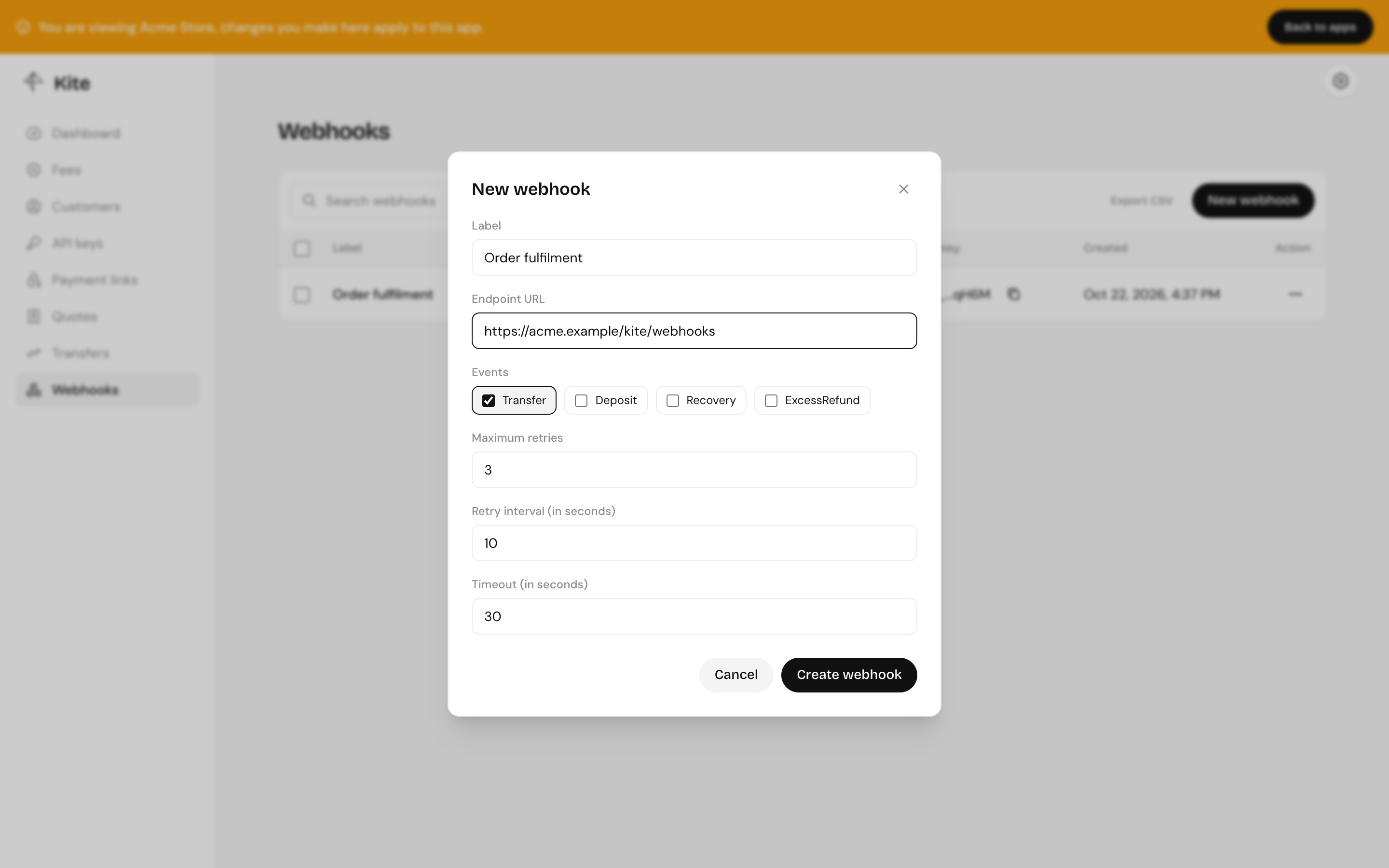
Copy the signing key it shows: you need it to verify deliveries, and it's shown once.
What's sent
Each delivery is a POST with a JSON body:
{
  "id": "4f1c…",
  "eventId": "9b2e…",
  "webhookId": "71d0…",
  "category": "Transfer",
  "previous": { "status": "Processing" },
  "current": { "status": "Settled" },
  "data": {
    "id": "7f3c2a10-…",
    "status": "Settled",
    "payinAddress": "0x…",
    "settlementBlockchainHash": "0x…",
    "quote": {
      "sourceAmount": "49000000",
      "sourceToken": { "symbol": "USDC", "decimals": 6 },
      "customer": null,
      "paymentLink": {
        "id": "d097df9a-…",
        "title": "Pro plan",
        "reference": "order-2041",
        "meta": null
      }
    }
  }
}| Field | Description |
|---|---|
id | This delivery. Each retry has a new one. |
eventId | The event. The same across retries: use it to ignore repeats. |
category | Transfer, Deposit, Recovery or ExcessRefund. |
previous, current | The status before and after. |
data | For transfers, the transfer with its quote, the quote's tokens, customer and payment link. |
And these headers:
| Header | Value |
|---|---|
X-Kite-Signature | Hex HMAC-SHA256 of t=<timestamp>&<raw body>, keyed with the signing key. |
X-Kite-Timestamp | Unix seconds when it was sent. |
X-Kite-Event-Id | The event's ID. |
Verifying with the SDK
Pass the body exactly as it arrived, before any JSON parsing:
import express from "express";
import { verifyWebhook } from "@kite-01/sdk";

app.post(
"/kite/webhooks",
express.raw({ type: "application/json" }),
async (req, res) => {
const event = await verifyWebhook({
body: req.body,
headers: req.headers,
secret: process.env.KITE_WEBHOOK_SECRET!,
});

    if (event.category === "Transfer" && event.current.status === "Settled") {
      const transfer = event.data as {
        quote: { paymentLink: { reference: string | null } | null };
      };
      await fulfil(transfer.quote.paymentLink?.reference);
    }

    res.sendStatus(200);

},
);
verifyWebhook throws a WebhookVerificationError when the signature doesn't match or the delivery is more than 5 minutes old (tolerance changes that). Answer with a 4xx then.
Verifying without the SDK
import hashlib, hmac, time

def verify(body: bytes, signature: str, timestamp: str, secret: str) -> bool:
    if abs(time.time() - int(timestamp)) > 300:
        return False
    expected = hmac.new(
        secret.encode(), f"t={timestamp}&".encode() + body, hashlib.sha256
    ).hexdigest()
    return hmac.compare_digest(expected, signature)
Retries
Answer with any 2xx within the webhook's timeout to acknowledge a delivery. Anything else is retried, up to the webhook's maximum retries, with its retry interval between attempts. Every attempt, with the response your endpoint gave, is listed under the webhook in the dashboard.
Do slow work after answering. Acknowledge first, then fulfil the order from a
queue, keyed by eventId so a retry never fulfils twice.